
Since late September, an AI browser agent called Muse has logged into test.leonix.io, our public demo of agent detection, about 95 times. Each visit gave us a close look at what an agent looks like from the website's side of the screen.
Muse came from the same browser fingerprint every single time. Its cloud machine, its graphics stack and its networks barely changed in five weeks. Its behavior is a different story. Somewhere around October 17, Muse started acting less like a script and more like a human hand.
A mouse that never misses the middle
People are sloppy with a mouse. We land a little left, a little low, wherever the cursor happened to stop. Almost nobody hits the exact center of a button, and certainly not every time.
Muse did. Through mid-October, 97% of its clicks landed dead-center on whatever it clicked. That is the signature of software computing a button's coordinates and clicking the midpoint.
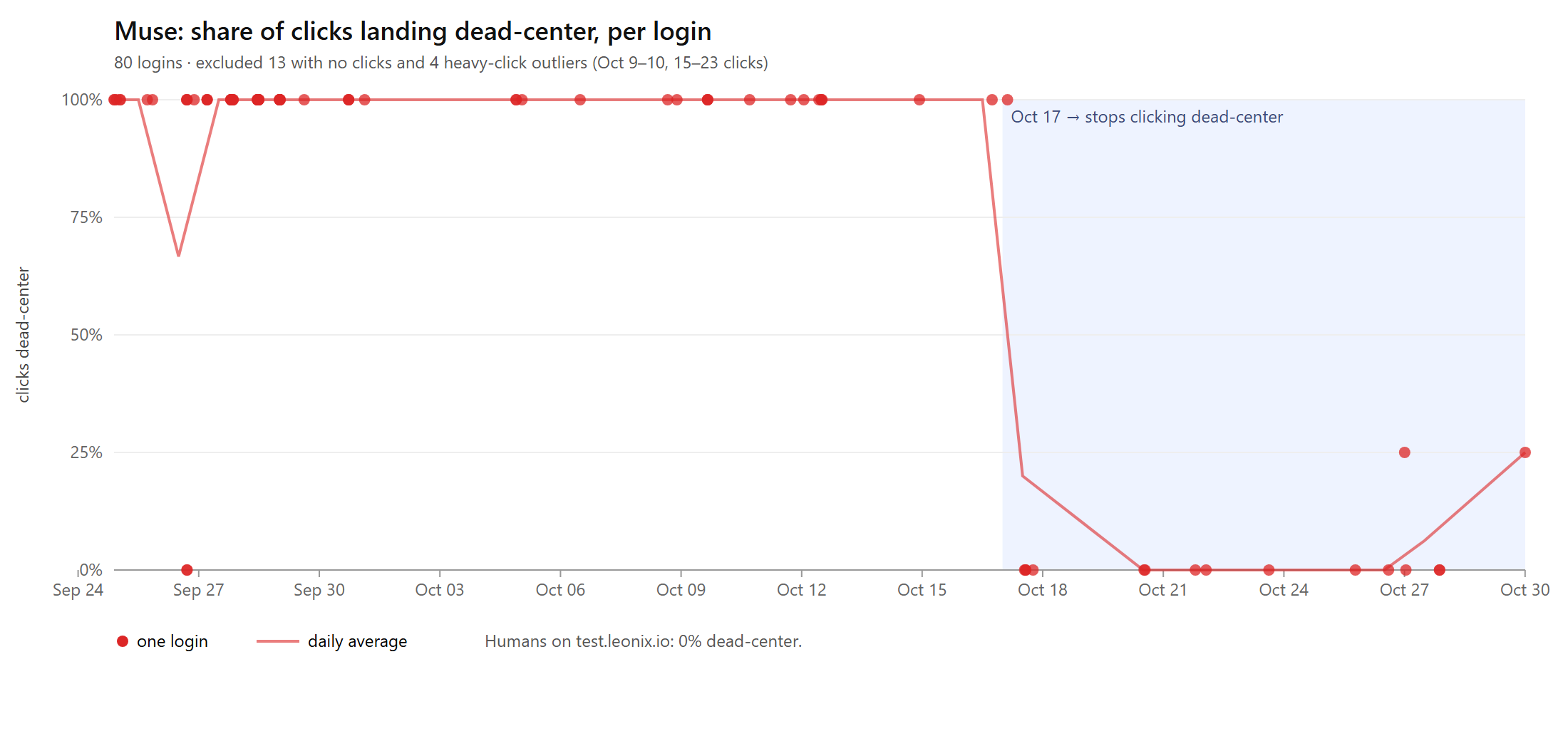
Then, on October 17, it stopped. The share fell to 9% and has stayed near zero since. Muse now clicks off-center, the way a person would.
Typing with a heartbeat
The second change shows up in how Muse types. When a person types, the pause between keys wanders. Familiar letter pairs come quickly, awkward reaches come slowly, and attention drifts. Across real users on our page, the pause between keystrokes varies by about 96 milliseconds.
Before October 17, Muse's pauses barely varied at all. The spread had a median of 15 ms. Every key arrived on almost the same beat, like a metronome.
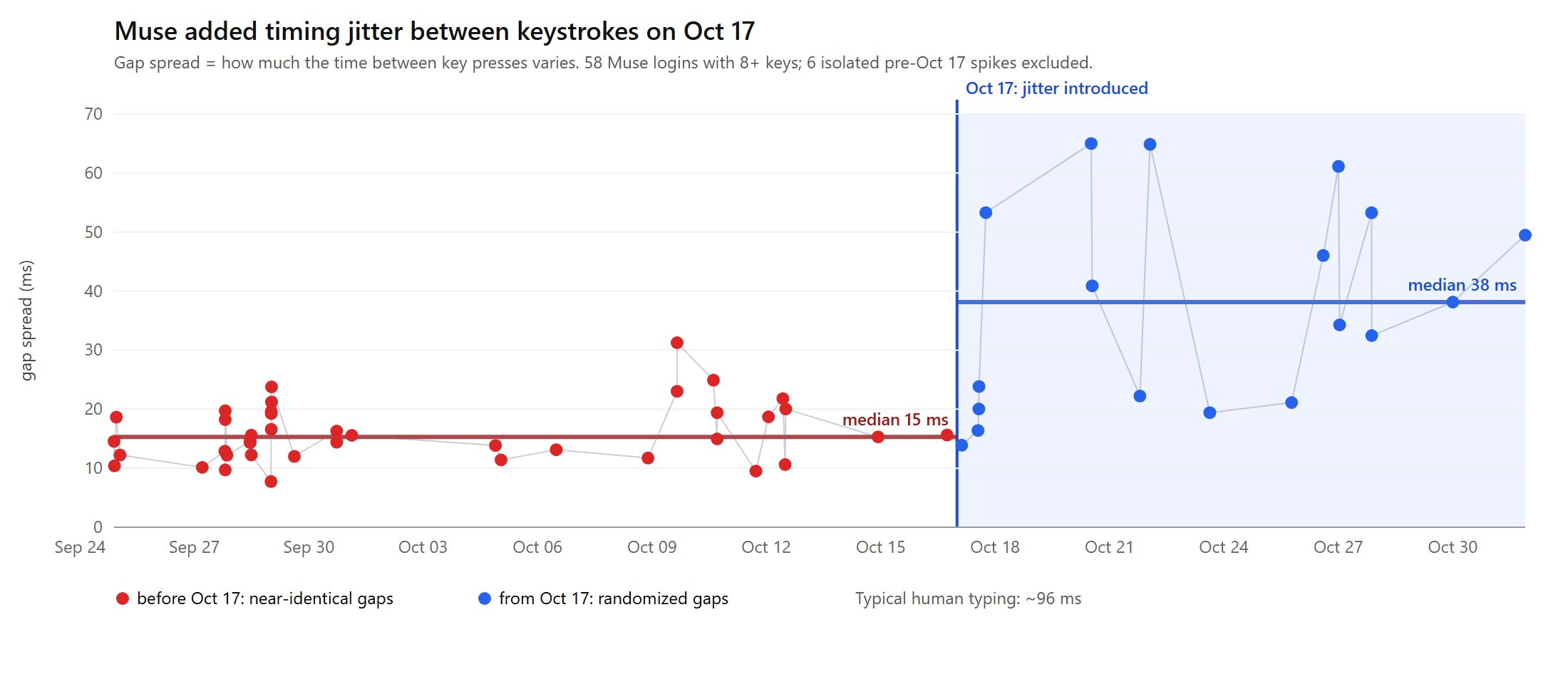
On October 17 the beat loosened. The median jumped to 38 ms, and the points scatter across a much wider band. Muse had started adding random delay between keystrokes. Engineers call this jitter.
Two changes, same day. Muse stopped clicking the middle of buttons and started randomizing its typing.
What this tells us
The lesson isn't about one agent. Agents are software, and software gets updated. Any single tell, however reliable today, has a shelf life. Muse kept the same fingerprint for five weeks and then rewrote two behaviors in one day.
So detection can't hinge on one signal. It has to read many independent signals together, behavior and environment alike, so that fixing one habit doesn't make an agent invisible. It also has to keep watching. The charts above exist because we label agent sessions and track them over time, which is how a change like October 17 shows up as a visible step instead of a silent miss.
We'll keep publishing what we see as agents learn to blend in.
Method: logins to test.leonix.io by the Muse agent, Sep 24 – Oct 31, 2026, captured by Leonix behavioral telemetry. "People" figures come from labeled human logins on the same page. Sessions with no clicks, too few keystrokes to measure, or isolated one-off spikes are excluded from the charts as noted. We don't publish the thresholds behind our ML model-driven behavior scores.